
The best kpop club activities fall into a short, reliable list: trivia and quiz rounds, Random Play Dance, karaoke, Running Man–style team challenges, photocard trading and customization, comeback or listening parties, dance practice sessions, and craft or photo-zone stations. Most clubs build meetings around two or three of these, running sessions of 60 to 90 minutes with a rotating theme so members always know roughly what to expect while still getting something new each week.
Here's a shortlist to pick from before your next meeting, with a one-line read on who each idea suits best:
- K-pop trivia and quizzes — best for mixed-experience groups who want low-pressure competition; scales from casual to hardcore.
- Random Play Dance (RPD) — best for performance-curious members and beginners who want to join without formal practice.
- Karaoke night — best for casual socializers who want music without choreography pressure.
- Running Man–style team challenges — best for larger groups (10+) who want physical, high-energy activity.
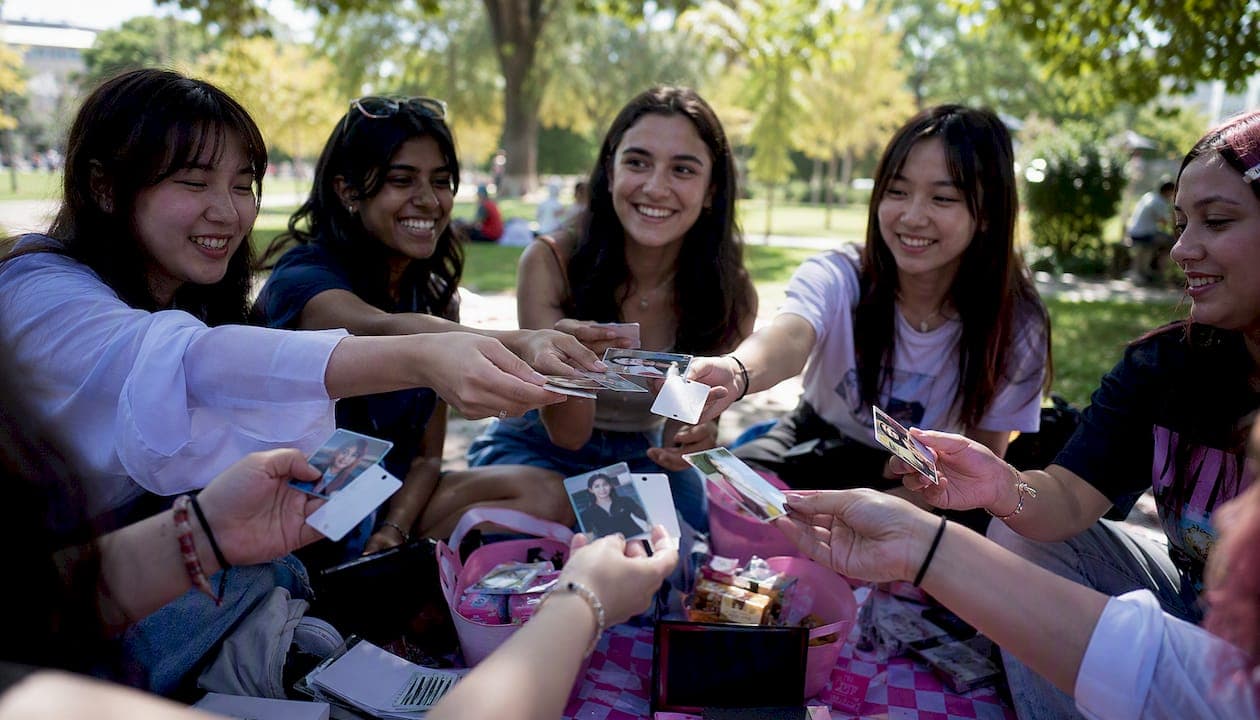
- Photocard trading and customization — best for collectors and crafters who want a quieter, hands-on activity.
- Comeback or listening parties — best for groups who want a built-in reason to meet on a release schedule.
- Dance practice sessions — best for members chasing a performance or showcase goal.
- Craft and photo-zone stations — best for smaller clubs or those wanting a low-cost, drop-in-friendly format.
- Blind-test music rounds — best for hardcore fans who want a harder trivia variant.
- Themed watch parties (variety shows, MVs) — best for discussion-driven members who like unpacking content together.
Key Takeaways
The most reliable kpop club activities combine low setup cost, short time blocks of 60 to 90 minutes, and a mix of social, competitive, and creative formats so every member type finds something to enjoy.
| Point | Details |
|---|---|
| Start with icebreakers | Bias share and name-that-lyric formats take 5 to 10 minutes and welcome new members without pressure. |
| Rotate game formats | Trivia, blind tests, Random Play Dance, and Running Man–style challenges keep weekly meetings from feeling repetitive. |
| Plan for accessibility and consent | Offer beginner lanes for dance sessions and always ask before filming or sharing clips online. |
| Assign clear roles | An MC, timekeeper, materials lead, and safety contact keep meetings running smoothly regardless of turnout. |
| Try KpopQuiz for trivia nights | Run a quick quiz from KpopQuiz's beginner collection as a low-stakes rehearsal before your next full trivia event. |
Table of Contents
- What Are the Easiest Kpop Club Activities to Start a Meeting?
- Which Games Keep a Kpop Club Meeting Competitive and Fun?
- How Do You Run a Dance Practice or Karaoke Night Fairly?
- What Materials Do You Need for Photocard Trading and Crafts?
- How Do You Plan a Themed Meetup or Watch Party?
- What Are Good Discussion and Culture Activities?
- How Do You Run Kpop Club Activities for Remote Members?
- How Do You Plan a Kpop Club Meeting on a Budget?
- What Do Two Copyable Meeting Agendas Look Like?
- How Do You Run an Engaging Kpop Trivia or Quiz Session?
- How Do You Include Members of Different Ages and Experience Levels?
- How Do You Handle Group Conflicts and Different Fan Opinions?
- How Can a Kpop Club Support Fan Projects and Charity?
- Organizer Perspective: What Tends To Work in Real Clubs
- Use Quizzes to Boost Kpop Club Engagement
- Frequently Asked Questions
- Sources
What Are the Easiest Kpop Club Activities to Start a Meeting?
Icebreakers do one job: get strangers talking about something they already love without making anyone perform. The strongest ones run 5 to 10 minutes and work for groups of any size, from a five-person dorm meetup to a 40-member campus society.
Organizers who treat these openers as genuinely social, rather than a warm-up to "the real event," tend to see better follow-through week to week. That framing matters because LSU's K-Pop Club built its entire identity around this idea, positioning lighthearted icebreakers like bias-sharing as the foundation for mutual respect among members who might otherwise never talk.
Try rotating through these formats:
- Bias share — each member names their current bias and one reason why, keeping it under 30 seconds per person.
- Two truths and a K-pop lie — members state three "facts" about a group or member; the group guesses the false one.
- Name-that-lyric — play five seconds of a chorus and see who can name the song first.
- Photocard show-and-tell — members bring one card and explain why it's their favorite pull.
- Speed meet-the-fan rounds — pair members for 90 seconds each, then rotate, so everyone talks to at least four people.
- Debut year guessing game — call out a group name and have members guess the debut year within a two-year range.
- Fandom name matchup — call out a group and have members shout the fandom name back.
- "Would you rather" K-pop edition — quick forced-choice questions (comeback vs. world tour, visual vs. vocal line) to spark quick debate.
Community clubs that lean on this format, including groups the Star News profiled in National City, use bias-sharing specifically because it lowers the bar to entry. Nobody has to know choreography or trivia facts to join in.
Pro Tip: Hand out blank index cards or name tags before bias share so people can write their bias down first. This takes the pressure off speaking on the spot and gives shy or new members something to hold onto while they talk.
Which Games Keep a Kpop Club Meeting Competitive and Fun?
Games are where most clubs generate their loudest energy, and the format you pick should match your group's size and comfort with performance. A 10-person living room meetup needs a different game than a 40-person auditorium event.
Here are five formats worth keeping in rotation:
- Trivia and quiz rounds. Split into teams of three to five. Read questions aloud (or project them) covering discography, debut dates, and member facts. Score one point per correct answer, with bonus points for speed. A tool like KpopQuiz's trivia library can supply ready-made question sets so nobody has to write 40 questions from scratch.
- Blind-test clips. Play 5 to 10 second song clips and have teams buzz in (or raise a hand) to name the track and group. This format works especially well for comeback season because you can build a set list entirely from new releases.
- Match-Up pair games. Show a photo or clip and have members match songs to groups, or members to their stage names. This rewards recall speed over deep trivia knowledge, which makes it more approachable for newer fans.
- Random Play Dance rules. Play a medley of choruses; anyone who knows the choreography steps forward and dances until the song cuts. RPD events are traditionally held in public squares, but the format adapts easily to a gym, community room, or backyard.
- **Running Man–style team challenges. Split into teams for physical mini-games (name tag ripping, relay races, scavenger hunts tied to K-pop trivia questions). Score points per challenge won, then total at the end.
Materials stay simple across all five: a speaker, a projector or printed question sheets, scoreboards (a whiteboard works fine), and small prizes. Stickers, extra photocards, or fan-made badges cost little and keep the stakes fun rather than serious. For tie-breakers, a sudden-death round, usually one blind-test clip or one rapid-fire trivia question, settles things fast without dragging the meeting past its time slot.
Pro Tip: Keep each game to 15 to 20 minutes max, including setup and scoring. Longer than that and even enthusiastic groups start losing focus, especially in a 60-minute meeting.
How Do You Run a Dance Practice or Karaoke Night Fairly?
Performance activities are where inclusivity planning matters most, because they're the activities most likely to make a new or shy member feel like they don't belong. The fix isn't complicated: build sign-up lanes and be upfront about what's optional.
Here's a checklist that works whether you're running dance practice, karaoke, or both in the same session:
- Pick songs in advance and post the list. Give members a few days' notice so anyone who wants to practice at home can do so.
- Assign a teacher or leader role. This doesn't need to be a professional choreographer. Any member who knows the routine well enough to break it into 8-counts can lead. Professional-led classes often run 90-minute blocks that split time between warm-up, choreography breakdown, and a final run-through, which is a solid template even for a volunteer-led session.
- Warm up for 5 minutes. Basic stretching prevents injury and signals that the session is starting.
- Separate performer and audience sign-ups. Not everyone wants to dance or sing in front of the group. Give a clear, no-pressure way to opt into "audience only."
- Set a filming policy before anyone performs. Ask the group whether clips can be recorded and shared on social media, and let anyone opt out by staying off camera or asking that their section be cut.
- Wrap with a group song or dance. Ending on something everyone can join, even just clapping along, keeps the energy positive regardless of individual performance levels.
Accessibility tip: offer a beginner lane that walks through a simplified 8-count version of the choreography, separate from the full routine practiced by more experienced dancers. This single adjustment is often the difference between a member coming back and a member quietly dropping off the group chat.
Pro Tip: Announce the "no filming without asking" rule at the start of every performance session, not just the first one. New members join throughout the year and won't know your club's norms unless you repeat them.
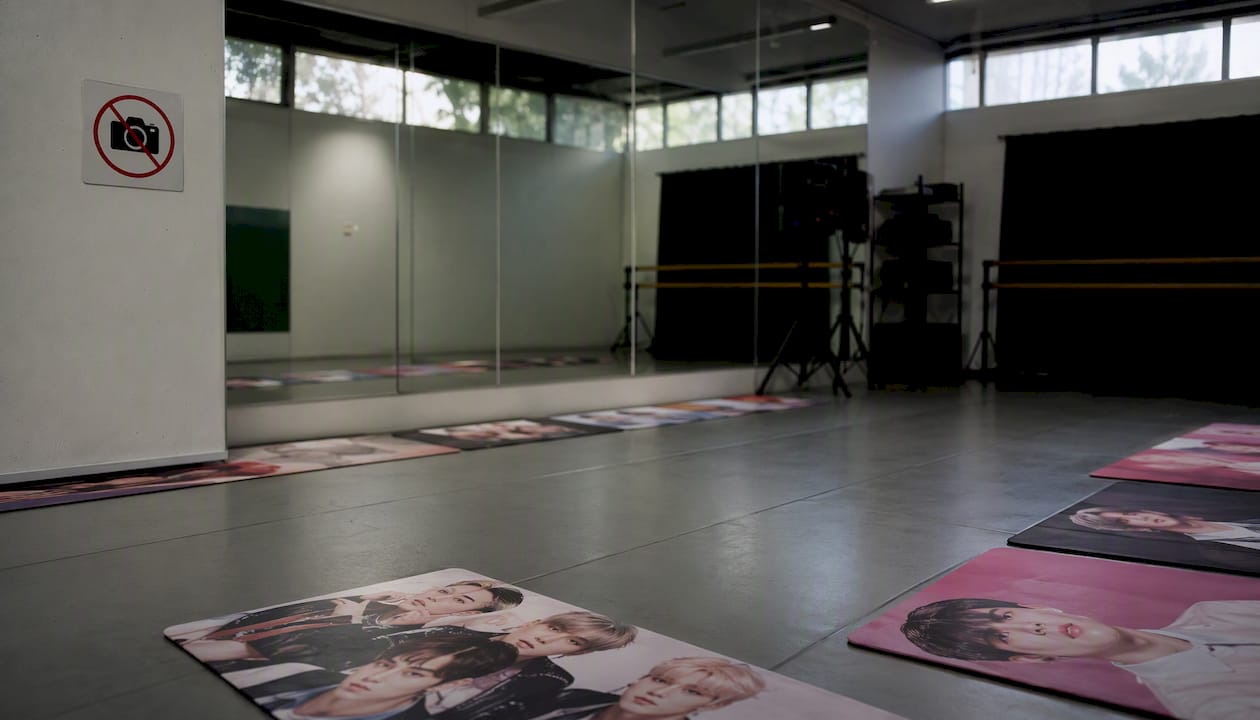
A short note on consent: always ask before filming, and offer a visible way to opt out, such as a designated "no-camera zone" at the back of the room. This matters as much for a 10-person club as a 100-person one.
What Materials Do You Need for Photocard Trading and Crafts?
Photocard culture runs on small, low-cost supplies, which makes it one of the cheapest categories of activity to run repeatedly. A basic materials kit covers most sessions:
- Protective card sleeves (toploaders or soft sleeves)
- Fine-tip markers and gel pens for customization
- Washi tape and stickers for decorating binders or cardholders
- Small binder pages or trading folders
- Blank labels or index cards for trade listings
Trading itself needs a few ground rules to stay friendly. Cards should be clearly labeled with the member's name and asking price or trade preference, and swap tables should be set up so members can browse without crowding around one person. Photocard trading etiquette generally comes down to fairness and clarity: no pressuring a trade, no misrepresenting a card's condition, and no trading personal information beyond what's needed for the swap.
Clubs with younger members or first-time traders should build in a few extra safeguards. New traders sometimes don't know what a card is actually worth, and it's easy for an eager collector to accidentally (or not so accidentally) make a lopsided trade.

Pro Tip: Assign one experienced member as a "trade helper" at swap tables. Their job is simply to answer pricing questions and step in if a trade looks unbalanced, especially useful for minors or brand-new members who don't yet know market value.
How Do You Plan a Themed Meetup or Watch Party?
Themed events give your club a reason to meet beyond "it's Tuesday again." Comeback parties, birthday cafes, and chimaek (chicken and beer, or chicken and soda for a dry event) nights all work because they attach the meeting to something time-bound and shareable.
A basic checklist covers most themed formats:
- Decor tied to the theme (posters, banners, group colors)
- A playlist built around the occasion (new comeback tracks, a member's solo discography for a birthday)
- One themed food or menu item, even something simple like snacks in the group's official color
- A photo zone with a printed backdrop or standee for pictures
Timing depends on the format. A one-off comeback listening party or watch party works fine as a single 60 to 90 minute session. Birthday cafes, on the other hand, often run for several days to a week, especially when a club partners with a local café for a cupsleeve event, where the venue puts a custom sleeve on drinks featuring the idol's photo for the duration of the promotion.
Partnering tip: approach a local café or bakery early, ideally a month out, and offer to bring in foot traffic during a slow period (weekday afternoons work well). Most venues are receptive to a cupsleeve or themed menu partnership because it costs them little and draws a crowd of fans who'll likely buy something anyway.
Pro Tip: If you're doing a cupsleeve-style event, remind members that supporting the partner venue with a purchase, even something small, is part of the etiquette. Cafes are far more likely to say yes to a repeat partnership if the first one actually brought business.
What Are Good Discussion and Culture Activities?
Learning-focused sessions round out a club's calendar and appeal to members who want more than games and performance. These work best as short, 10 to 20 minute segments rather than full meetings, either as a standalone mini-lesson or a lead-in to a longer discussion.
A few formats that consistently work:
- Hangul basics. Teach the 14 consonants and 10 vowels of the Korean alphabet over a few sessions, then quiz the group on reading simple album titles.
- Music video breakdowns. Pick one MV and discuss its symbolism, choreography choices, or callback references to earlier eras.
- Variety show clip comparisons. Watch short clips from different shows featuring the same group and discuss how their concept shifts.
- Lyric translation discussion. Compare official English releases to fan translations and talk through what nuance gets lost.
- Guest speaker slots. Invite a member (or outside speaker) who's studied Korean or lived in Korea to share firsthand context.
Handle sensitive cultural topics carefully. Frame discussions about genuine curiosity rather than assumption, avoid reducing any part of Korean culture to a stereotype, and if the topic goes beyond your group's knowledge (religious practices, historical context, regional dialects), consider bringing in an actual guest speaker rather than guessing. Follow every micro-lesson with a short open Q&A so members can ask questions without feeling like they're interrupting a lecture.
How Do You Run Kpop Club Activities for Remote Members?
Not every member lives close enough to attend in person, and hybrid formats let clubs keep remote fans engaged without running two completely separate programs. The tools are simple: a video-conferencing platform for the group call, plus a shared-play platform or screen-share setup for anything visual, like a blind test or quiz.
For live trivia and blind tests, share your screen during a video call so remote and in-person members see the same question or clip at the same time. Chat-based answer submission works well for remote players since it prevents anyone from shouting out and spoiling the round for people on a slight delay.
Trading and swag swaps get trickier online since there's no table to browse. A remote photocard swap generally needs a bit more structure than an in-person one:
- Post a shared spreadsheet or thread where members list cards available for trade.
- Agree on shipping costs upfront, usually split evenly or covered by the receiving member.
- Use tracked shipping and photograph the card's condition before mailing, which protects both sides if a card arrives damaged.
- For higher-value cards, consider a trusted third member acting as a go-between (a light "escrow" role) so neither trader sends first without some assurance.
Running a genuinely good hybrid meetup, not just a stream of the in-person one, takes a few adjustments: set clear camera rules (remote members should be visible if comfortable, but never required to be on camera), assign someone as a dedicated remote MC who checks the chat and voices remote questions aloud, and stagger your agenda so remote members aren't just watching an in-person icebreaker they can't participate in.
How Do You Plan a Kpop Club Meeting on a Budget?
Planning gets easier once you separate the recurring logistics from the one-time decisions. Start with a basic checklist:
- Pick a venue. A dorm common room, library study room, community center, or a member's living room all work for groups under 20. Larger clubs may need to book a campus space or rent a small studio.
- Check permits or booking rules. Campus spaces often require advance reservation; public parks used for Random Play Dance may require a permit for larger gatherings.
- Consider health and safety basics. For large in-person gatherings, plan for adequate ventilation, keep a first-aid kit on hand, and have a clear plan if someone needs to step out or feels unwell.
- Confirm insurance if applicable. Campus-affiliated clubs often fall under university insurance; independent community clubs renting a space should check what the venue requires.
- Set a rough budget. Even a $0 meeting benefits from knowing what you'd spend if you wanted to add prizes or snacks.
Cost benchmarks vary a lot by activity type, but real examples help set expectations:
Accessibility deserves its own checklist, separate from the budget:
- Reserve a quiet space or corner for anyone who needs a sensory break during louder activities.
- Post clear signage for the room, restroom locations, and any activity stations.
- Confirm wheelchair access for the venue, especially for dance or Running Man–style physical challenges.
- Keep content age-appropriate if the club includes minors, and flag any mature discussion topics in advance.
- Have a designated contact person members can approach privately if they feel uncomfortable during an activity.
What Do Two Copyable Meeting Agendas Look Like?
Here's a 60-minute agenda for a tighter weekly meetup:
- 0 to 10 minutes: Icebreaker (bias share or name-that-lyric).
- 10 to 35 minutes: One main game (trivia round or blind test).
- 35 to 50 minutes: Craft or discussion segment (photocard customization or a short culture mini-lesson).
- 50 to 60 minutes: Wrap-up, announcements, and next meeting preview.
And a 90-minute agenda for a fuller monthly or themed event:
- 0 to 10 minutes: Icebreaker and welcome for new members.
- 10 to 20 minutes: Warm-up dance or karaoke opener.
- 20 to 45 minutes: Main game block (trivia plus a Running Man–style challenge, or RPD session).
- 45 to 60 minutes: Themed segment (comeback listening party, watch party, or craft station).
- 60 to 80 minutes: Photocard trading and free social time.
- 80 to 90 minutes: Wrap-up, prize announcements, next meeting preview.
Assign four roles before every meeting so nothing falls through the cracks: a host/MC to keep the agenda moving, a timekeeper to flag when segments are running long, a materials lead who brings supplies and sets up stations, and a safety/contact lead who members can approach with concerns. For groups under 10, one person can double up on roles; for anything over 25, keep the roles separate so no one is stretched too thin. Adjust game complexity based on experience level, too. A club full of new fans benefits from easier trivia difficulty and more beginner-lane dance options, while a veteran group can handle blind tests and harder Running Man–style physical challenges.
How Do You Run an Engaging Kpop Trivia or Quiz Session?
Trivia is the single most repeatable activity on this list because it scales from five people to fifty and needs almost no physical space. Running one well comes down to five steps:
- Pick your question source. Write your own set, or pull from an existing library like KpopQuiz's quiz collection to save prep time, especially useful when you need a fresh set every week.
- Set difficulty to match your group. Mix easy and hard questions rather than running a whole session at one level. A beginner-friendly set, like KpopQuiz's easy quizzes, works well as an opening round before harder questions come out.
- Split into teams and assign a scorekeeper. Teams of three to five keep everyone involved without slowing down each round.
- Run multiple rounds with a scoring leaderboard. Track points on a whiteboard or shared screen so teams can see standings update live.
- Announce winners and deliver prizes on the spot. Momentum drops fast if there's a delay between the final question and the payoff.
A simple leaderboard might look like this after three rounds:
Ties break with a single sudden-death question, ideally a blind-test clip, so the whole room stays engaged through the final call.
For organizers who want to keep difficulty calibrated over time, tools built specifically for this help more than a spreadsheet. A platform like KpopQuiz offers blind test, match-up, and leaderboard formats organizers can lean on instead of building everything from scratch, and reviewing aggregated fan quiz data can show which topics and difficulty levels tend to land best with different fan groups, which is useful if your club's trivia nights keep running either too easy or too hard.
How Do You Include Members of Different Ages and Experience Levels?
Age and fan-experience gaps show up in almost every club, and the fix is rarely to run separate programming. It's to build in options within the same activity. Trivia rounds work for this naturally: pair a newer fan with a veteran on the same team so knowledge gaps balance out rather than becoming a source of embarrassment.
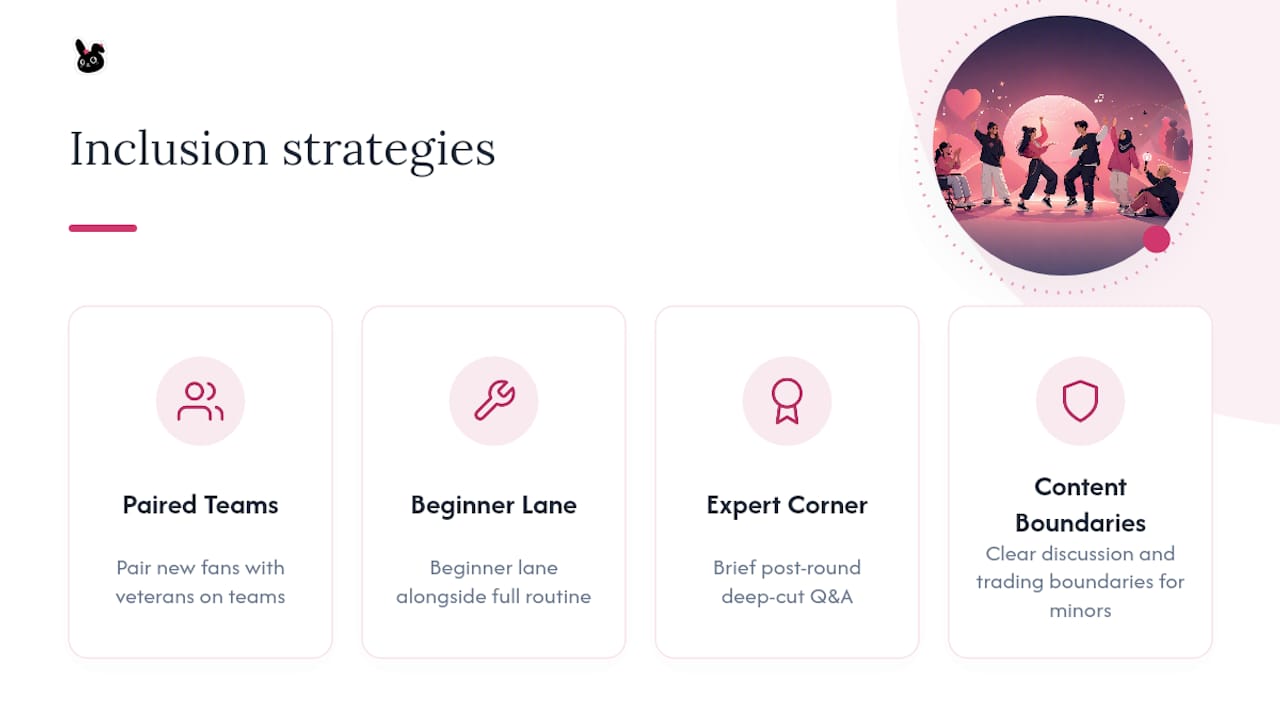
For dance and performance activities, a beginner lane alongside the full routine (mentioned earlier) does the heavy lifting. The same principle applies to trivia difficulty. Structure rounds so easier questions come first, building confidence before harder ones arrive.
Younger members, especially minors, benefit from clear content boundaries around discussion topics and trading interactions, while older or more experienced fans sometimes want deeper trivia or performance challenges to stay engaged. A rotating "expert corner," where a knowledgeable member briefly answers deep-cut questions after the main trivia round, gives advanced fans a outlet without making the main activity inaccessible to newcomers.
How Do You Handle Group Conflicts and Different Fan Opinions?
Fandom disagreements happen in every club: bias wars, stan-versus-stan tension, or disputes over a trade that felt unfair. Most of these are minor and resolve on their own, but a club with no plan for the bigger ones will eventually lose members over an avoidable blow-up.
Set expectations early, ideally in your very first meeting, that the club is a shared space for multiple fandoms and opinions, not a platform for one group's fans to dominate discussion or dismiss another. Assigning a safety/contact lead (mentioned in the sample agendas) gives members a specific person to flag concerns to privately, rather than airing a dispute in front of the whole group.
For trading disputes specifically, having a designated trade helper at swap tables (covered in the crafts section) prevents most conflicts before they start, since an experienced third party can flag an unbalanced trade before it happens rather than mediating after the fact. When a genuine conflict does arise between members, address it privately and quickly rather than letting it simmer through group chats, where misunderstandings tend to escalate fast.
How Can a Kpop Club Support Fan Projects and Charity?
Fan projects and charitable giving give a club purpose beyond entertainment, and they don't need to be complicated to matter. A birthday project for a member's bias, pooling small donations for a cake-and-donation drive timed to the idol's birthday, is a common and low-cost starting point.
Clubs can also organize donation drives tied to cause an artist or group has publicly supported, or run a small fundraiser (bake sale, raffle of donated photocards) with proceeds going to a local charity. Streaming parties, where members gather to collectively stream a comeback's music video or track, sometimes double as a fundraiser if the club adds a small suggested donation for attendance.
Keep these projects optional and transparent. Not every member wants to or can contribute financially, so frame charitable activities as an invitation rather than an expectation, and always share where donations actually went once a drive wraps up.
Organizer Perspective: What Tends To Work in Real Clubs
Clubs that last more than a semester or two tend to share a few traits, and none of them are flashy. They meet on a consistent schedule, whether that's weekly or biweekly, because unpredictable timing is one of the fastest ways to lose casual members who need the meeting to become a habit. They also keep the barrier to entry low: a taster session or a beginner-lane option at every event, rather than assuming new members will figure out the group's inside jokes and dance routines on their own.
The clubs that get this right treat "safe space" as an operating principle, not a slogan. That means genuinely welcoming new biases, new fandoms, and different levels of K-pop knowledge without letting one dominant friend group set the tone. University societies that run both casual and skill-based programming, think chimaek nights alongside weekly dance classes, tend to retain a wider range of members than clubs that only do one or the other.
Small giveaways matter more than their price tag suggests. A sticker or extra photocard costs almost nothing, but it turns an ordinary trivia night into something members look forward to. Clear roles help too. When one person is always the MC and another always handles materials, meetings run smoothly even when attendance fluctuates week to week.
None of this requires a large budget or a big membership roster. It requires consistency, a genuine welcome for beginners, and a plan for the handful of things (trades, conflicts, filming) that can quietly derail an otherwise good club if nobody thinks about them ahead of time.
Use Quizzes to Boost Kpop Club Engagement
Trivia rounds are one of the easiest activities to keep fresh, and that's exactly the gap KpopQuiz is built to fill. Its blind-test format works as a ready-made music round for listening or comeback parties, its match-up games slot directly into icebreaker or team-split segments, and its quiz library covers everything from beginner-friendly rounds to deep-cut trivia for members who want a real challenge.
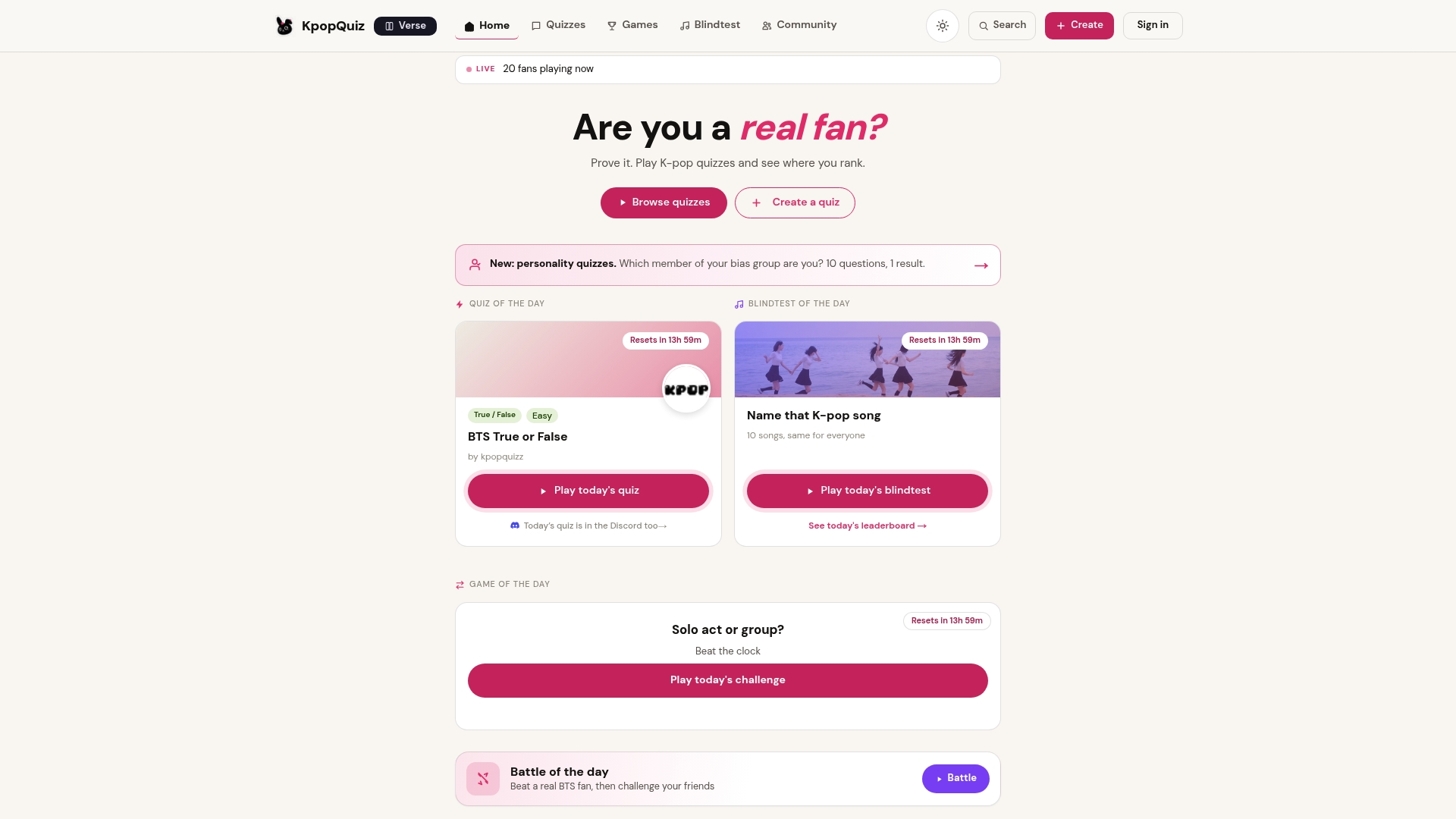
Organizers get a leaderboard built in, so there's no need to track scores by hand on a whiteboard, along with daily quizzes that keep members coming back between meetings and easy embed or share options if your club runs any part of its activity online. If your next meeting needs a trivia round, start by browsing KpopQuiz's full quiz collection and pick a set that matches your group's experience level.
Frequently Asked Questions
What are the best kpop club activities for a first meeting? Start with a low-pressure icebreaker like bias share or name-that-lyric, then run one easy trivia round. This combination introduces members to each other without requiring dance skill or deep trivia knowledge.
How long should a typical kpop club meeting run? Most clubs run meetings between 60 and 90 minutes, based on patterns seen across multiple campus and community clubs. Shorter sessions suit weekly meetups, while 90-minute agendas work better for monthly or themed events.
How do you start a kpop club from scratch? Pick a consistent meeting schedule, choose an accessible venue, and plan your first meeting around one icebreaker and one easy game. Building a habit matters more early on than having a packed activity list.
What do you need for a Random Play Dance session? Just a speaker and a playlist of chorus clips from popular songs. RPD works in a public square, a gym, or a living room, and it's beginner-friendly since anyone who knows the choreography can step in.
How do you keep photocard trading safe for younger members? Set clear trading rules, label cards with names and preferences, and assign an experienced member as a trade helper who can flag unbalanced trades before they happen.
Can kpop club activities work for remote or hybrid members? Yes. Live trivia and blind tests translate well to video calls with screen sharing, and remote photocard swaps work with a shared trade list, tracked shipping, and a trusted go-between for higher-value cards.
Sources
A few primary sources are worth bookmarking if you're building out a full club calendar:
- LSU’s K-Pop Club brings music, culture and community to campus
- Complete Guide to K-Pop Fan Events - K-Pop Tracker
- K-POP Society | Students Union UCL
- Fan culture promotes ‘bias’ at National City club meetings | The Star News